
Most clients assume their attorney will simply keep them informed. Then weeks pass without a word, and suddenly you are wondering whether your case is moving at all. Attorney communication obligations explained clearly can change that experience entirely. Your attorney is not just ethically encouraged to communicate with you. They are legally required to. Understanding what those rules say, what you can reasonably expect, and what to do when things fall short puts you in a far stronger position during any legal matter.
Table of Contents
- Key takeaways
- Attorney communication obligations explained: the rules behind them
- What to expect in terms of timing and frequency
- Your role in making communication work
- Modern risks to confidentiality and privilege
- What to do when your attorney goes silent
- My honest take on attorney communication
- Get clarity on your legal situation today
- FAQ
Key takeaways
| Point | Details |
|---|---|
| Rule 1.4 is binding | Attorneys must keep you informed, consult you on decisions, and explain matters clearly under professional conduct rules. |
| Response time standard | Most clients should expect a reply to inquiries within 24 hours, even if only an acknowledgment. |
| Communication is two-way | Clients who provide honest, timely information help attorneys represent them more effectively. |
| AI tools carry real risk | Sharing legal details with public AI platforms can waive attorney-client privilege and expose your case. |
| You can take action | If your attorney goes silent, you have options including formal complaints and seeking a second opinion. |
Attorney communication obligations explained: the rules behind them
The foundation of every attorney's communication duty sits in Rule 1.4 of the Model Rules of Professional Conduct. This rule is not a suggestion. It is a binding professional standard that governs how attorneys must interact with the people they represent.
Rule 1.4 requires attorneys to do four specific things:
- Promptly inform you of any decision or circumstance that requires your consent before the attorney can act
- Consult with you about the goals of your case and how those goals will be pursued
- Keep you reasonably informed about significant developments in your matter
- Explain your situation clearly enough that you can make informed decisions
That last point matters more than people realize. Your attorney cannot simply act on your behalf and report back. They must give you enough information to participate in your own case. That is a meaningful distinction.
There are some limited exceptions. A court may issue a protective order that restricts what your attorney can share with you. In rare situations involving third-party interests or ongoing investigations, disclosure may be temporarily limited. But these exceptions are narrow. They do not give attorneys permission to go silent for weeks.
One thing worth understanding is the difference between substantive communication and automated updates. Getting an automated text saying "your document was filed" is not the same as your attorney explaining what that filing means for your case. Automated notifications do not replace genuine attorney-client interaction and can leave clients feeling overlooked if that is all they receive. Meaningful communication involves context, explanation, and the opportunity for you to ask questions.
| Type of communication | What it looks like | Does it satisfy Rule 1.4? |
|---|---|---|
| Automated case status alert | "Your hearing is scheduled for June 10." | No, not on its own |
| Attorney email with context | Explanation of what the hearing means and what to expect | Yes |
| Voicemail with next steps | Attorney summarizing developments and asking for your input | Yes |
| No contact for 3+ weeks | Silence during an active matter | No |
What to expect in terms of timing and frequency
Knowing your rights under Rule 1.4 is one thing. Knowing what that looks like in practice is another.
The industry-standard communication cadence for active legal matters is contact every 7 to 14 days. That does not mean a full case update every week. It means your attorney should be checking in, flagging any changes, and confirming that your case is progressing. For matters that are in a quieter phase, the frequency may be lower. But you should never go more than two weeks without some form of meaningful contact during an active case.
Response time is a separate issue. Most clients expect a reply to email inquiries within 24 hours, even if that reply is just an acknowledgment that your message was received. That standard is widely recognized in legal practice and reflects a basic level of respect for your time and your concerns.
The expected frequency also shifts depending on where your case stands:
- Pre-filing: Your attorney should be gathering information, explaining the process, and setting expectations. Expect regular contact as your case is being built.
- Discovery: This is often the most active phase. Updates should come more frequently as documents are exchanged and depositions are scheduled.
- Trial preparation: Communication should be very active. You need to understand what is happening, what your role is, and what outcomes are possible.
- Post-judgment: Contact may slow down, but your attorney should still walk you through next steps, appeals options, or enforcement actions.
Pro Tip: Keep a simple log of every time you contact your attorney and every time they respond. Note the date, method, and what was discussed. This record protects you if a dispute arises later about communication failures.
Clients who receive proactive updates tend to make fewer follow-up calls and report higher satisfaction with their representation. That is good for everyone. Attorneys who build structured communication schedules into their workflow also see fewer bar complaints, according to research on communication cadence.
Your role in making communication work
Attorney communication is not a one-way street. Your attorney has obligations, but you have responsibilities too. Understanding both sides leads to a much better working relationship.
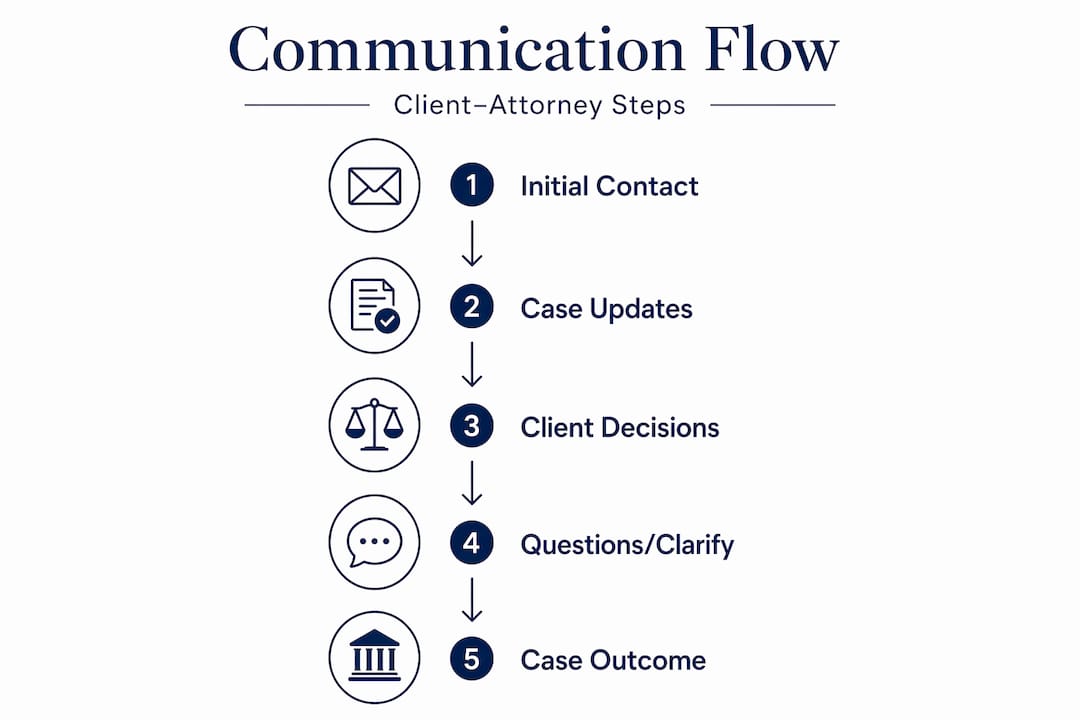
Effective representation depends on client honesty. If you leave out details because they seem embarrassing or irrelevant, your attorney may build a strategy on incomplete information. That can cause serious problems later. Tell your attorney everything, even the parts that do not seem important. Let them decide what matters.
Here are some practical guidelines to keep your side of the communication clean:
- Respond promptly. When your attorney asks for documents, signatures, or answers, do not delay. Slow client responses are one of the most common reasons cases stall.
- Use secure channels. Send sensitive information through your attorney's official email or client portal, not through social media messages or public apps.
- Avoid oversharing publicly. Do not post about your case on social media. Even vague references can be used against you.
- Ask questions in writing. Sending questions by email creates a record and gives your attorney time to respond thoughtfully.
- Set communication preferences early. At the start of your representation, ask your attorney how and when they prefer to communicate. Setting clear expectations early prevents misunderstandings down the line.
Pro Tip: You do not need a separate NDA with your attorney. Attorney-client privilege begins from your very first consultation, even before you formally hire them. Your conversations are already protected.
Modern risks to confidentiality and privilege
Digital communication has made attorney-client interaction faster and more convenient. It has also introduced new risks that most clients are not aware of.
The biggest one right now involves AI tools. Many people use public AI platforms to help them understand their legal situation, draft questions for their attorney, or summarize documents. That feels harmless. It is not.
- Public AI tools are not confidential. When you paste legal details into a free AI chatbot, you are sharing that information with a third party. That can inadvertently waive attorney-client privilege by introducing an outside party into what should be a protected conversation.
- Unsecured email carries risk. Sending sensitive case details over a personal email account that lacks encryption is not the same as using your attorney's secure client portal.
- Text messages are discoverable. Standard SMS messages are not encrypted and can be subpoenaed. Use them for scheduling, not for case strategy.
- Social media is never private enough. Even direct messages on social platforms can be accessed through legal discovery processes.
- Screenshots and forwarded messages lose context. When you forward legal communications to friends or family for advice, you may be weakening the protection that privilege provides.
Attorneys are increasingly expected to guide clients on digital hygiene as part of their professional responsibilities. If your attorney has not discussed these risks with you, it is worth raising the topic yourself. Ask what communication methods they consider secure and follow their guidance.
What to do when your attorney goes silent

You know your rights. You know what good communication looks like. So what happens when your attorney is not meeting those standards?
Signs that something is wrong include:
- No contact for more than two weeks during an active matter
- Unanswered calls or emails for more than 48 hours with no acknowledgment
- Vague responses that do not actually address your questions
- Missing deadlines without explanation
- Feeling like you are always the one initiating contact
If you recognize these signs, start by addressing it directly with your attorney. Send a written message stating that you have not received updates and that you need a status report by a specific date. Keep the tone professional. Many communication gaps come from workflow issues, not negligence.
If that does not work, you have real options. Every state has a bar association that handles complaints about attorney conduct. Filing a formal complaint is a serious step, but it is your right if communication obligations are not being met. You can also request your file and consult a second attorney to assess whether your representation has been adequate.
Tracking your attorney communications and maintaining records is one of the most practical things you can do throughout your case. Those records become your evidence if a dispute arises. Attorneys spend roughly 20 to 30 percent of their day managing client communication, which shows how central it is to the practice of law. When that time is not being invested in your case, you deserve to know why.
My honest take on attorney communication
I have spent years looking at how attorney-client relationships succeed and fall apart. The pattern is almost always the same. Communication breaks down not because attorneys are careless, but because law firms often lack structured systems for staying in touch with clients. Attorneys are managing multiple cases, court deadlines, and administrative demands at once. Without a deliberate process, communication slips.
What I have found is that clients who speak up early get better service. If you tell your attorney at the start of your representation exactly how often you need updates and what format works best for you, most attorneys will adapt. They want satisfied clients. They just do not always know what you need unless you say it.
The harder truth is that some attorneys genuinely do not meet their obligations. When that happens, clients often feel embarrassed to push back or unsure whether their expectations are reasonable. They are almost always reasonable. Rule 1.4 exists because the legal system recognized that clients need information to participate in their own defense or pursuit of rights.
My advice: treat communication expectations as part of the initial conversation with any attorney you hire. Ask directly how they handle updates, what their response time policy is, and who else on their team you can contact. That one conversation sets the tone for everything that follows.
— Ayomikun
Get clarity on your legal situation today
If you are trying to understand your rights before hiring an attorney, or if you are already in a representation and feeling lost, Justicebridgetechnologies built a platform specifically for this moment. Lexura gives you free access to legal education tools that help you understand your situation without any pressure to commit.

You can use the free legal triage tool to organize your circumstances through guided questions, understand which legal topics apply to your situation, and get clarity before you ever speak to an attorney. When you are ready to connect with representation, Lexura's attorney search directory helps you find licensed attorneys near you. No obligation. No hidden fees. Just the information you need to move forward with confidence.
FAQ
What does Rule 1.4 require of attorneys?
Rule 1.4 of the Model Rules of Professional Conduct requires attorneys to keep clients informed about significant case developments, consult on objectives, obtain informed consent before major decisions, and explain matters clearly enough for clients to make their own choices.
How quickly should my attorney respond to my messages?
The recognized standard is a response within 24 hours to client inquiries, even if it is just an acknowledgment. For active matters, substantive updates should come every 7 to 14 days.
Can I lose attorney-client privilege by using AI tools?
Yes. Sharing confidential legal details with public AI platforms can waive privilege by introducing a third party into protected communications. Use only secure, attorney-approved channels for sensitive information.
What should I do if my attorney stops communicating?
Send a written request for a status update with a clear deadline. If there is no response, you can contact your state bar association to file a complaint or consult another attorney about your options.
Does attorney-client privilege start before I officially hire a lawyer?
Yes. Confidentiality protections apply from your very first consultation, even if you have not signed a retainer or paid any fees. You do not need a separate agreement to protect that initial conversation.